
For years, smartphone manufacturers convinced consumers to upgrade their devices by introducing better cameras, larger displays, faster processors, longer battery life, and sleeker designs. These improvements were easy to notice and made each new generation feel significantly better than the last.
Today, however, smartphones have reached a level of maturity where even devices that are three or four years old still perform exceptionally well. They handle daily tasks, capture high-quality photos, stream videos smoothly, and last throughout the day with little difficulty. As a result, manufacturers face a new challenge: how do they convince people to upgrade a phone that already works perfectly?
The answer is artificial intelligence.
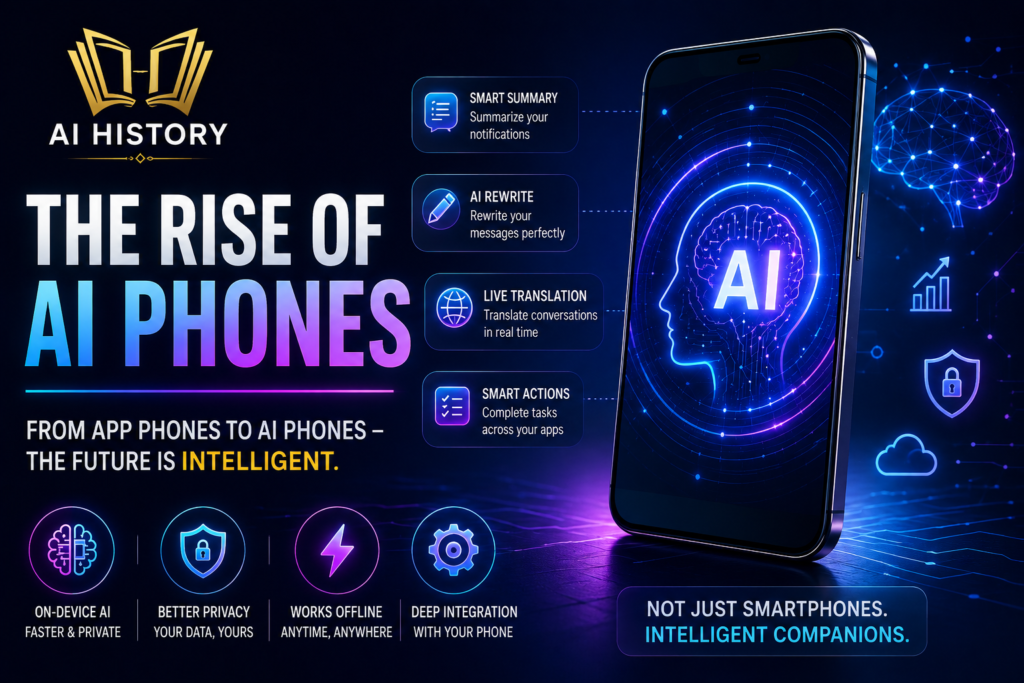
From App Phones to AI Phones
The smartphone industry is entering a new era. Instead of competing solely on hardware, companies are building devices designed to understand users rather than simply respond to their commands.
Traditional smartphones operate like toolboxes. They contain apps for messaging, browsing, photography, and productivity, but every action depends on the user opening the correct app and performing each step manually.
AI-powered smartphones work differently. They understand context, summarize notifications, rewrite messages, translate conversations in real time, search files by meaning instead of keywords, and increasingly perform tasks across multiple applications automatically.
This marks a fundamental shift—from phones that execute commands to phones that actively assist users.
Apple Is Only the Beginning
Apple has made this transition particularly visible with Apple Intelligence. Unlike ordinary software updates, Apple Intelligence requires specific hardware, supported devices, and additional storage before it can even be activated.
Many existing iPhones simply cannot support these features because they lack the required memory and processing capabilities. Although this has drawn attention to Apple, the same trend is spreading throughout the technology industry.
Google is developing Gemini Nano to run AI directly on Android devices, while Samsung continues expanding Galaxy AI across its flagship smartphones. Qualcomm is designing its newest processors with AI performance as a primary objective rather than focusing only on speed.
This transformation extends beyond smartphones and will eventually influence tablets, laptops, wearable devices, and even automobiles.
Why AI Requires New Hardware
Running advanced AI locally demands much more than a fast processor.
Modern AI systems require:
Large amounts of unified memory
Dedicated Neural Processing Units (NPUs)
Storage space for AI models
Efficient battery systems capable of sustained computation
Unlike conventional apps, AI models constantly process language, images, and context in real time. Older hardware may continue running the latest operating system smoothly but still lack the resources needed for advanced AI features.
As a result, two categories of smartphones are emerging:
Phones that continue functioning normally.
Phones capable of delivering advanced AI experiences.
This distinction is largely invisible. There is no warning message or broken screen—only the absence of increasingly important features.
A New Reason to Upgrade, In previous years, upgrades were driven by visible hardware improvements. Today, manufacturers are creating a different motivation. Instead of asking, “Does your phone have a better camera?” consumers will increasingly ask, “Can my phone understand what I need?”
As AI assistants become more capable of organizing schedules, summarizing information, answering questions, managing notifications, and working across apps, users may begin to feel limited—not because their phones are slow, but because they lack intelligence.
The upgrade decision becomes less about specifications and more about productivity and convenience.
Cloud AI vs. On-Device AI
Some may argue that older phones can simply use cloud-based AI services like ChatGPT or Gemini through the internet.
While this is true, cloud AI has limitations.
Cloud services require internet connectivity, may experience delays during heavy usage, can raise privacy concerns because data leaves the device, and often involve ongoing subscription costs.
On-device AI offers several advantages:
Faster responses
Improved privacy
Offline functionality
Lower long-term operating costs
Deep integration with the operating system
The future is likely to combine both approaches. Smaller, everyday tasks will be processed directly on the device, while larger or more complex requests will be handled in the cloud. Even this hybrid model, however, depends on hardware capable of supporting local AI.
The Emerging AI Divide. The greatest impact of this transition may not be that older phones stop working. Instead, intelligence itself may become unevenly distributed across devices. Some users will own smartphones that summarize lectures, organize research, translate conversations, plan schedules, and provide proactive assistance throughout the day.
Others will own smartphones that still run every app but cannot access these intelligent capabilities because their hardware was never designed for them. This creates a new form of digital divide—not based on internet access, but on access to AI-powered assistance.
Most populated Applications are used on phones: ChatGPT, Google Gemini, Microsoft Copilot, Apple Intelligence, Samsung Galaxy AI, Meta AI, Claude AI, Perplexity AI, Grok AI, DeepSeek AI, Google Lens Circle to Search, Grammarly AI, Notion AI, Adobe Firefly, Canva AI, CapCut AI, ElevenLabs Otter AI and Microsoft Designer.
Conclusion
The smartphone is not disappearing, but its purpose is changing dramatically. For more than a decade, innovation centered on cameras, displays, processors, and design. The next generation of smartphones will compete primarily on intelligence.
Your next upgrade may not be necessary because your current phone is broken. It may become necessary because your current phone cannot participate in the AI-powered future. The era of the “app phone” is gradually giving way to the era of the “AI phone,” where the most valuable feature is no longer what your device can do, but what it can understand.
FAQs
1. What is an AI phone?
An AI phone is a smartphone that uses artificial intelligence to understand user context, automate tasks, summarize information, translate conversations, and provide personalized assistance instead of simply running apps based on manual input.
2. Why do new AI features require newer smartphones?
Modern AI features require advanced hardware such as Neural Processing Units (NPUs), larger memory, faster processors, and sufficient storage to run AI models efficiently on the device. Older phones may support the latest operating system but still lack the hardware needed for these capabilities.
3. Can older smartphones still use AI features?
Yes, older smartphones can access cloud-based AI services like ChatGPT or Gemini through the internet. However, they may not support advanced on-device AI features due to hardware limitations, resulting in slower responses and reduced functionality.
4. What is the difference between cloud AI and on-device AI?
Cloud AI processes requests on remote servers and requires an internet connection, while on-device AI runs directly on the smartphone. On-device AI offers faster performance, better privacy, offline functionality, and deeper integration with the operating system.
5. Will AI become the main reason to upgrade smartphones?
Increasingly, yes. As smartphone hardware improvements become less noticeable, AI capabilities are emerging as the primary reason for upgrading. Future buying decisions are likely to focus more on intelligent assistance than on camera quality or processor speed alone.
6. Which smartphone brands are leading the AI phone revolution?
Major technology companies including Apple, Google, Samsung, and Qualcomm are investing heavily in AI-powered smartphones. Features such as Apple Intelligence, Google Gemini Nano, and Galaxy AI demonstrate the industry’s shift toward intelligent, AI-first devices.
7. What is the AI divide in smartphones?
The AI divide refers to the growing gap between smartphones that can run advanced AI features locally and those that cannot. While older devices may continue functioning normally, they may miss out on intelligent capabilities such as real-time assistance, contextual understanding, and proactive automation, creating a new form of digital inequality.
Suggested important Article for ImpHistory.com
- The History of Artificial Intelligence
- Evolution of Cybersecurity
- How Ransomware Works
- Biggest Cyber Attacks in History
- Future of Artificial Intelligence
- What is Machine Learning?
- History of the Internet
- Understanding Zero Trust Security





Recent Comments