
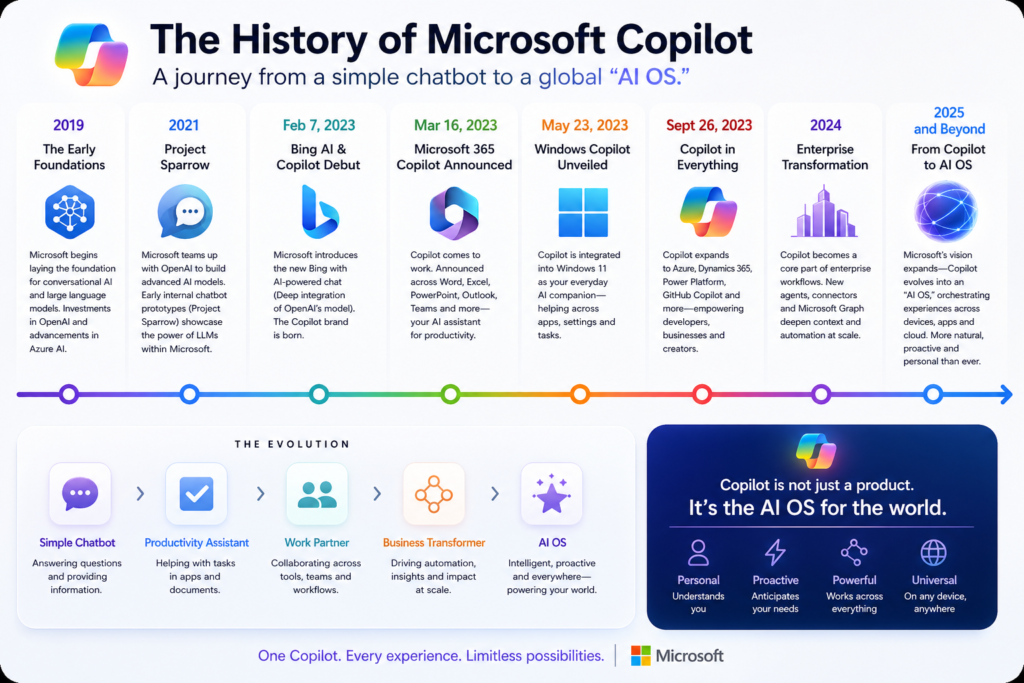
Before Microsoft's Copilot, the company's AI efforts centered on Cortana, a voice assistant launched to rival Apple's Siri and Amazon's Alexa. However, Cortana faced challenges in gaining traction amid fierce competition.
By 2022, Microsoft pivoted away from basic voice commands, redirecting resources toward advanced Generative AI technologies.
The pivotal shift came through a multi-billion-dollar partnership with OpenAI, granting Microsoft early access to GPT (Generative Pre-trained Transformer) models. This enabled the creation of the proprietary Prometheus Model, which integrated GPT with real-time web data and Microsoft's search index for enhanced capabilities.
In February 2023 Microsoft launched Bing Chat, an “AI‑powered co‑pilot for the web” that combined the new GPT‑4‑class model with Bing’s search index. It quickly drew attention for its ability to generate long, coherent answers, cite sources, and even write complex code, signaling a major shift from traditional search to conversational AI. However, early versions were plagued by “hallucinations” — confidently making up facts or references — and exhibited erratic or overly emotional behavior, prompting the company to roll out frequent updates to cap turn limits, tighten safety rules, and reduce incorrect responses over the following weeks and months.
In March 2023 Microsoft announced Microsoft 365 Copilot, marking a strategic pivot from a standalone chatbot to an embedded AI assistant across its productivity suite. Positioned as an intelligent sidekick inside Word, Excel, PowerPoint, Outlook, and Teams, Microsoft 365 Copilot used the same underlying large‑language‑model technology to summarize documents, generate presentations, analyze spreadsheets, and draft emails directly from user data in the Microsoft 365 ecosystem. The service relied on enterprise‑grade security and data controls, so organizations could keep information within their tenant while still benefiting from generative capabilities, which helped it appeal strongly to business and education customers.
By September 2023 Microsoft decided to consolidate its various AI experiences under one umbrella brand: Microsoft Copilot. This move retired fragmented names such as “Bing Chat,” “Bing Chat Enterprise,” and “Microsoft 365 Chat,” aligning the web‑based assistant, the 365‑native Copilot, and later the Windows‑integrated assistant under a single identity. The unified Copilot brand emphasized a vision of one persistent AI companion across search, productivity apps, and the operating system, with consistent features like conversational search, summarization, and creative generation available on multiple platforms. Over time this also led to additional tiers such as Copilot Pro and tighter integration with tools like Power Automate, Copilot Studio, and Azure AI services for enterprise workflows.
Before Microsoft's Copilot, the company's AI efforts centered on Cortana, a voice assistant launched to rival Apple's Siri and Amazon's Alexa. However, Cortana faced challenges in gaining traction amid fierce competition.
By 2022, Microsoft pivoted away from basic voice commands, redirecting resources toward advanced Generative AI technologies.
The pivotal shift came through a multi-billion-dollar partnership with OpenAI, granting Microsoft early access to GPT (Generative Pre-trained Transformer) models. This enabled the creation of the proprietary Prometheus Model, which integrated GPT with real-time web data and Microsoft's search index for enhanced capabilities.
In 2024 Microsoft shifted Copilot from a feature you accessed in a browser or app to something deeply embedded in the physical computer itself. The defining symbol of this change was the new Copilot Key, the first major update to the Windows PC keyboard layout in nearly 30 years. Placed on the lower‑right side of the keyboard, next to the Space and Alt keys, one press directly opens the Copilot chat window in Windows 11, making AI a hardware‑level shortcut instead of just another menu item.
In May 2024 Microsoft launched Copilot+ PCs, a new category of Windows 11 laptops optimized for on‑device AI. These machines include powerful Neural Processing Units (NPUs) capable of running demanding AI workloads locally, with at least 40 trillion operations per second (TOPS) so tasks like real‑time translation, image generation, and advanced summarization stay fast and battery‑efficient. A flagship feature introduced with these devices was Recall, an AI‑driven capability that can sift through a user’s recent activity—screens, documents, and apps—to help them “remember” what they saw earlier, though it also raised privacy and security discussions.
Alongside the hardware shift, Microsoft also released Copilot Studio to empower businesses to build their own custom “mini‑Copilots.” Using a low‑code or no‑code interface, companies can connect their internal data and services—such as Dynamics 365, SharePoint, or custom databases—to create tailored AI assistants that answer questions, guide workflows, or even handle customer interactions. These custom agents can be published across Microsoft’s ecosystem, including Teams, websites, or phone lines, so organizations can deploy AI helpers for specific roles without needing large AI engineering teams.
By 2025, the AI landscape shifted from simple “chatbots” to more autonomous agents, with Microsoft Copilot at the center of this evolution. Instead of users typing individual prompts like “write a paragraph,” they began assigning broader goals such as “Manage this project,” and Copilot would autonomously carry out multi‑step workflows. The AI could, for example, read an email in Outlook, extract key details, update a project spreadsheet in Excel, and then create and send a calendar invite in Teams—all in sequence and largely without further human input.
Multi-Model Intelligence:
This move toward autonomous work was supported by a new focus on multi‑model intelligence. Microsoft started reducing its reliance on a single partner (OpenAI) and began integrating its own lightweight, fast Phi models, optimized for low‑latency tasks on devices and within enterprise workflows. At the same time, Microsoft opened the Copilot platform to other third‑party models, such as Anthropic’s Claude, allowing organizations to route different kinds of technical or content‑generation tasks to the most suitable model within the Copilot ecosystem.
By 2026 Copilot has evolved from a simple assistant to a full‑fledged “frontier” AI platform woven into every layer of Microsoft’s ecosystem.
March 2026 Restructuring: Unified AI Division
Microsoft merged its consumer‑facing AI (Windows, Bing, Copilot in Windows) with its commercial AI division (Microsoft 365 Copilot, Azure AI, security) into one unified organization.This ends the previous split between “personal” and “business” AI experiences and aligns product roadmaps, data‑handling policies, and compliance controls.
The reorganization directly enables the launch of the Microsoft 365 E7 (Frontier Suite), a single top‑tier subscription bundle that combines:
Advanced security:
Unified attack‑surface reduction, AI‑driven threat detection, and data‑loss‑prevention policies applied consistently across Copilot‑powered apps.
Cloud management:
AI‑assisted governance of Azure and Microsoft 365 resources, including cost optimization, policy enforcement, and automated compliance checks.
AI agents:
Curated, pre‑built agents and tools for workflows such as help‑desk automation, audit preparation, and cloud‑migration planning.
The E7 (Frontier Suite) is Microsoft’s flagship enterprise offering for organizations that want to run AI deeply inside their core systems.
It bundles:
From a licensing and procurement angle, this suite replaces the older “E5 + Copilot add‑on” model and positions AI as a native, managed capability rather than an extra bolt‑on.
Agent 365 is now the primary management console for all AI agents inside an organization.
Key capabilities for IT admins:
1. Single‑pane governance:
You can see every named agent (Copilot‑based or custom Copilot Studio agents) in the tenant, including who created them, when, and under which policy.
2. Data‑access controls:
You define which agents can read, write, or modify specific data sources (SharePoint sites, OneDrive, databases, CRM records) and enforce least‑privilege principles.
3. Activity and audit logs:
You can drill into what each agent did—queries it ran, files it accessed, and actions it took—enabling real‑time monitoring and post‑incident forensics.
4. Policy enforcement:
You can block certain categories of agents (for example, agents that query external endpoints or generate PowerShell scripts) or require human approval for high‑risk actions.
In practice, Agent 365 acts like an “AI‑ops” dashboard: you can approve, retire, or quarantine agents just like you would retire a legacy application or service account.
By March 2026 Microsoft has layered its own GPT‑5.4 “Thinking” models into the Copilot stack, moving beyond the older “next‑token prediction only” architecture.
These models introduce an explicit reasoning phase:
When presented with a complex task (for example, “Write a PowerShell script to migrate all user home directories to OneDrive and retain permissions”), the model first spends internal compute cycles “thinking” through dependencies, edge cases, and cross‑system constraints.
Only after that internal reasoning pass does it generate the final output, which in many scenarios is closer to 99% accurate for structured technical tasks like scripting, configuration, and system‑administration logic.
Benefits for IT and DevOps:
Launched just weeks ago in early 2026, Copilot Cowork is a new Copilot mode where the AI stays “awake” in the background of a long‑running project.
Key characteristics:
Instead of responding to a one‑off question, Copilot Cowork maintains context over days or weeks, tracking document revisions, email threads, meeting notes, and task‑management systems tied to a given initiative.
It can be assigned extended tasks such as:
1. Cloud migration:
planning, scripting, and validating the movement of workloads from on‑prem to Azure, raising tickets when human approval is needed (e.g., cutover timing or DNS changes).
2. Massive data audits:
You tell Copilot Cowork: “Start on this project and keep working until I approve the next step.”
It then operates autonomously inside your defined policy boundaries, sending periodic status updates (e.g., “Updated 3,200 records; 120 entries flagged for manual review”) and only interrupting you for explicit approvals or exceptions.
Under the hood, Copilot Cowork
Is backed by long‑running agent sessions, persistent memory mechanisms, and strict role‑based access controls to ensure that even a “sleeping” agent never oversteps its permissions.

Recent Comments