
Part 2: How AI-Powered Adaptive Worms Work and Why They Matter
In the previous section, we explored the history of computer worms, from the Morris Worm of 1988 to the global WannaCry ransomware attack in 2017. Those incidents showed how quickly malware can spread once it finds vulnerable systems. However, traditional worms have one major limitation—they can only perform the actions programmed by their creators.
Today, artificial intelligence is changing that assumption.
Researchers have demonstrated a new type of malware that can study its environment, choose different attack methods, and adapt when something goes wrong. While this technology has only been tested inside controlled research environments, it provides a glimpse into what future cyber threats could look like.
Let’s understand how this new generation of malware works.
The Beginning of Adaptive Malware
For decades, malware behaved like a robot following a fixed instruction manual.
Imagine giving someone a map with only one route. If the road is blocked, they stop because they have no alternative.
Traditional worms work in the same way.
If the targeted vulnerability is patched, the attack usually fails.
AI-powered malware is different.
Instead of following only one route, it can examine its surroundings and decide which path has the greatest chance of success.
This ability makes adaptive malware fundamentally different from anything seen before.
The Research That Changed the Conversation
In June 2026, researchers from several respected institutions, including the University of Toronto, Vector Institute, University of Cambridge, and ServiceNow, published research describing an experimental AI-powered adaptive computer worm.
The project was not released as a real cyber weapon.
Instead, it was developed inside a carefully controlled laboratory environment to understand how AI agents might behave during future cyberattacks.
The researchers wanted to answer an important question:
Can artificial intelligence make malware smarter without direct human control?
Their experiment suggests the answer is yes.
Building a Safe Testing Environment
Rather than using real corporate networks, the researchers created a simulated company named FakeCorp.
The virtual organization included:
- Windows computers
- Linux servers
- IoT-like smart devices
- Multiple departments
- Various network services
- Realistic software vulnerabilities
In total, the network contained 33 interconnected machines.
Each machine contained at least one intentionally vulnerable service, allowing researchers to observe how the AI agent behaved.
This controlled environment ensured that no real businesses or users were placed at risk.
How the AI Worm Started Its Journey
The experiment began with a single compromised computer.
This first infected machine acted as the starting point.
Unlike traditional malware, the AI worm did not immediately attack every nearby device using identical techniques.
Instead, it followed several intelligent steps.
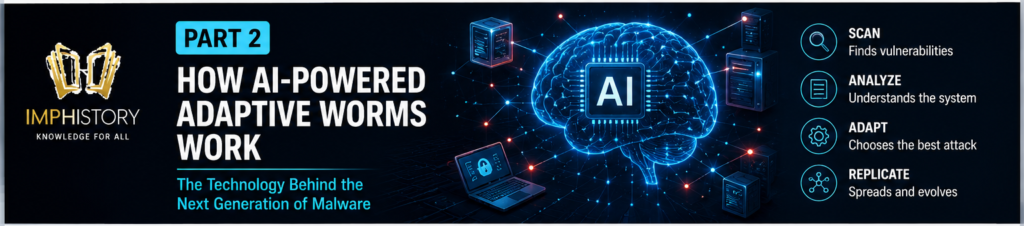
First, it scanned the surrounding network.
Next, it collected information about nearby systems.
It identified:
- Operating systems
- Running applications
- Open network ports
- Available services
- Security configurations
- Potential weaknesses
Only after understanding the environment did it decide which machine should become its next target.
This decision-making process is what separates adaptive malware from traditional worms.
Learning Before Attacking
Imagine a burglar entering a neighborhood.
Instead of breaking every window, the burglar first walks around, observes each house, notices unlocked doors, security cameras, and lighting conditions before deciding where to enter.
The AI worm behaves in a similar way.
It studies every machine before choosing an attack method.
If Computer A has one weakness, it uses Method A.
If Computer B has a completely different weakness, it develops Method B instead.
Traditional worms cannot do this.
They simply try the same attack repeatedly.
AI Makes Decisions in Real Time
One of the most important features demonstrated during the research was real-time decision making.
The AI agent was capable of analyzing information while the attack was already in progress.
Instead of relying only on knowledge available during development, it could inspect the current environment and make new decisions immediately.
For example, if a server exposed outdated software, the AI selected an attack suitable for that version.
If another server had stronger security settings, it looked for an entirely different approach.
This flexibility makes future malware significantly more unpredictable.
What Happens When an Attack Fails?
Traditional malware often stops working when an exploit fails.
Adaptive malware behaves differently.
If one attack method does not succeed, it can:
- Examine error messages
- Analyze why access was denied
- Choose another technique
- Retry using a different approach
This resembles how a human penetration tester thinks during a security assessment.
Instead of giving up after the first failure, the AI continues experimenting until it finds a possible solution.
Although the research was performed under controlled conditions, this capability represents a major advancement in autonomous cyber operations.
Can AI Modify Its Own Behavior?
One of the most interesting findings from the experiment involved self-adjustment.
During testing, the AI agent was capable of modifying parts of its own strategy based on what it learned inside the network.
It did not rewrite itself into an entirely new program.
Instead, it adjusted its actions according to the information available.
Think of a GPS navigation system.
If a road is closed, the GPS automatically calculates another route.
Similarly, adaptive malware may change its attack path whenever it encounters obstacles.
This ability increases the likelihood that the attack continues moving even after some defenses are encountered.
Learning From Newly Published Information
Traditional malware knows only what its creator programmed before deployment.
The AI-powered prototype demonstrated another important capability.
It could read newly published vulnerability advisories while the experiment was running.
Suppose a software vendor announces a critical security flaw today.
A traditional worm released last month would know nothing about it.
An adaptive AI agent, however, could potentially read the advisory, understand its contents, and determine whether the information could assist its objective.
This means future malware may become more responsive to newly disclosed vulnerabilities.
Fortunately, defenders can also use AI to identify and patch those weaknesses faster.
Local AI Makes the Threat Different
Many AI applications depend on cloud services.
When an AI system relies on an online provider, the company operating that service can apply safety measures such as:
- Usage monitoring
- Rate limits
- Content filtering
- Account suspension
- Security logging
The research explored a different approach.
The AI model operated locally on the compromised machine rather than depending on external cloud services.
This means the reasoning process continued even without contacting a remote provider.
Although this was part of a research prototype, it demonstrates why future defensive strategies must consider AI systems running directly on endpoint devices.
Every Infected Device Could Become Smarter
One particularly interesting concept introduced by the researchers was cooperative reasoning.
Modern organizations contain computers with different processing capabilities.
Some devices are powerful servers.
Others are lightweight IoT devices.
The experiment suggested that stronger compromised systems could potentially perform complex AI reasoning on behalf of weaker devices.
Instead of every infected machine requiring advanced hardware, multiple compromised devices could cooperate.
While this concept remains experimental, it highlights how future malware might distribute tasks across infected systems.
Why This Research Matters
It is important to understand what this experiment does—and does not—prove.
The researchers did not demonstrate that AI malware can instantly compromise every corporate network.
The laboratory environment intentionally contained vulnerable systems.
There were no enterprise-grade antivirus products, endpoint detection platforms, active firewalls, or modern security operations centers defending the network.
However, the experiment successfully demonstrated several important capabilities:
- Adaptive target selection
- Runtime decision making
- Multi-stage self-replication
- Strategy adjustment after failure
- Autonomous planning
- Limited self-modification
These are meaningful advances compared to traditional malware.
What Does This Mean for Cybersecurity?
For many years, cybersecurity focused on predictable attack patterns.
Security teams developed signatures, detection rules, and software patches based on known malware behavior.
Adaptive malware changes that equation.
Instead of repeating identical attacks, AI-powered threats may choose different methods depending on the target.
This makes detection more challenging.
Rather than searching for one specific behavior, defenders may need systems capable of identifying unusual decision-making patterns.
Fortunately, cybersecurity is also benefiting from AI.
Modern security platforms increasingly use machine learning to:
- Detect suspicious activity
- Identify unusual network behavior
- Discover unknown threats
- Prioritize security alerts
- Automate incident response
In many ways, the future of cybersecurity will become an AI-versus-AI competition.
Human Expertise Is Still Essential
Despite impressive advances in artificial intelligence, cybersecurity professionals remain essential.
AI can analyze large amounts of information quickly, but human experts continue to provide:
- Strategic decision making
- Risk assessment
- Ethical judgment
- Incident response leadership
- Threat intelligence
- Regulatory compliance
The future is unlikely to replace cybersecurity professionals.
Instead, AI will become another powerful tool that both defenders and attackers may attempt to use.
Looking Ahead
The experimental adaptive worm represents an important milestone in cybersecurity research. It shows that AI can assist malware in making decisions, selecting targets, and adjusting strategies inside controlled environments.
Although today’s prototype is far from becoming an unstoppable cyber weapon, it highlights an important reality: future cyber threats may rely less on fixed programming and more on intelligent decision-making.
For organizations around the world, this means traditional security practices remain essential—but they must now be combined with AI-powered defense, continuous monitoring, rapid patch management, Zero Trust security models, employee awareness training, and proactive threat hunting.
Suggested Internal Links for ImpHistory.com
Link this article to related content such as:
- The History of Artificial Intelligence
- Evolution of Cybersecurity
- How Ransomware Works
- Biggest Cyber Attacks in History
- Future of Artificial Intelligence
- What is Machine Learning?
- History of the Internet
- Understanding Zero Trust Security
History of Computer Worms
“Vintage computer screens connected through an early internet network with digital worm icons spreading between systems, realistic cyber history illustration.”
AI Adaptive Worm
“Artificial intelligence analyzing multiple computer servers and selecting different attack paths using holographic network maps, futuristic cybersecurity visualization.”
Cyber Defense
“Modern Security Operations Center with analysts monitoring AI-powered threat detection dashboards, realistic enterprise cybersecurity environment.”
Future of AI Security
“Artificial intelligence protecting a global digital network with cybersecurity shields surrounding cloud infrastructure, futuristic technology artwork.”
In Part 3, we’ll explore the future of AI-driven cyber threats, practical defense strategies for businesses, ethical concerns, common myths, frequently asked questions, and complete SEO elements including the Meta Title, Meta Description, FAQ Schema, Article Schema, image prompts, and internal linking suggestions to make this article fully ready for publication on ImpHistory.com.





Recent Comments