
Part 3: The Future of AI-Driven Cybersecurity, Defense Strategies, FAQs, and SEO Assets
Artificial Intelligence is transforming almost every industry. It helps doctors diagnose diseases, assists businesses in making smarter decisions, powers self-driving cars, and improves customer service through intelligent chatbots. However, like every powerful technology, AI has two sides. The same capabilities that help solve problems can also be misused by cybercriminals.
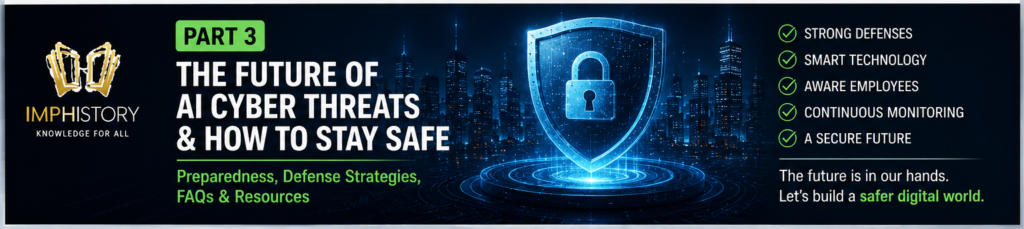
The research discussed in the previous sections does not mean that AI-powered worms are currently attacking organizations worldwide. Instead, it demonstrates that AI has the potential to make malware more adaptive, more flexible, and more autonomous than traditional cyber threats.
This raises an important question:
How should individuals, businesses, and governments prepare for this new generation of cyber threats?
Why This Research Matters
Many cybersecurity breakthroughs begin inside research laboratories.
Years before ransomware became one of the biggest cybersecurity threats, researchers had already demonstrated many of the techniques attackers would later adopt.
Similarly, AI-powered adaptive worms are currently research prototypes.
The value of this research is not to create dangerous software—it is to help cybersecurity professionals understand future risks before cybercriminals attempt to exploit them.
Understanding future threats today gives defenders valuable time to improve security technologies.
AI Is Changing Both Sides of Cybersecurity
One important fact is often overlooked.
Artificial Intelligence is not only helping attackers.
It is also making cybersecurity stronger.
Today, security teams use AI to:
- Detect malware faster
- Analyze millions of security events every day
- Identify suspicious user behavior
- Predict potential cyberattacks
- Automate incident response
- Reduce false security alerts
Instead of replacing cybersecurity experts, AI helps them work faster and more efficiently.
Future cybersecurity will likely become an AI-versus-AI environment, where intelligent defense systems continuously monitor networks while attackers attempt to develop smarter attack methods.
The Biggest Challenge Is Speed
Traditional cyberattacks often followed predictable patterns.
A vulnerability would be discovered.
Security researchers would publish information.
Software vendors would release updates.
Organizations would install those updates.
This process sometimes took weeks or even months.
Adaptive AI changes this timeline.
If future malware becomes capable of identifying weaknesses quickly and adjusting its behavior automatically, organizations may have far less time to respond.
This is why continuous monitoring is becoming more important than periodic security reviews.
Every Organization Can Become a Target
Large multinational companies are not the only organizations at risk.
Modern businesses of every size depend on connected technology.
Examples include:
- Hospitals
- Banks
- Schools
- Universities
- Manufacturing companies
- Government departments
- Retail stores
- Small businesses
Even smart office devices such as printers, surveillance cameras, conference room systems, and IoT sensors are connected to corporate networks.
Every connected device increases the overall attack surface.
Cybersecurity is no longer just an IT problem—it has become a business priority.
What Businesses Should Do Today
Although AI-powered adaptive worms remain experimental, organizations should strengthen their cybersecurity posture now.
The following best practices continue to provide strong protection against both traditional and emerging threats.
1. Keep Systems Updated
Software updates remain one of the most effective security measures.
Many large cyberattacks have succeeded because organizations delayed installing available security patches.
Automated patch management can significantly reduce risk.
2. Use Multi-Factor Authentication (MFA)
Passwords alone are no longer sufficient.
Even if attackers steal login credentials, Multi-Factor Authentication adds another layer of protection.
Organizations should enable MFA for:
- Email accounts
- VPN access
- Cloud services
- Administrative accounts
- Financial systems
3. Implement Zero Trust Security
Zero Trust follows a simple principle:
Never trust. Always verify.
Instead of assuming devices inside the corporate network are safe, every user and every device must continuously prove its identity.
This approach reduces the impact of compromised systems.
4. Segment Your Network
Large flat networks allow malware to spread quickly.
Network segmentation divides systems into smaller security zones.
If one area becomes infected, the attacker cannot easily move to every other device.
This simple strategy significantly limits lateral movement.
5. Monitor Continuously
Organizations should monitor:
- Login activity
- File changes
- Network traffic
- User behavior
- Privileged account usage
- Endpoint security alerts
Continuous monitoring helps detect suspicious activity before it becomes a major incident.
6. Train Employees Regularly
Technology alone cannot stop every cyberattack.
Employees remain one of the strongest defenses.
Regular awareness training should teach users how to:
- Identify phishing emails
- Verify unexpected links
- Report suspicious activity
- Avoid downloading unknown files
- Protect sensitive information
An informed workforce reduces the likelihood of successful attacks.
Ethical Questions About AI
The development of advanced AI raises important ethical questions.
Researchers must balance innovation with responsibility.
Some key questions include:
- Should AI research be limited?
- How much information should researchers publish?
- How can dangerous technologies be studied safely?
- Who is responsible if AI is misused?
- How can governments encourage innovation while protecting society?
These discussions will become increasingly important as AI capabilities continue to improve.
Will AI Replace Human Hackers?
Probably not.
AI can automate repetitive tasks and analyze large amounts of information quickly.
However, human attackers still provide:
- Creativity
- Strategic planning
- Social engineering
- Financial motivation
- Decision-making
Similarly, human cybersecurity professionals remain essential for:
- Incident response
- Risk management
- Security architecture
- Digital forensics
- Threat intelligence
- Regulatory compliance
The future is likely to involve humans and AI working together on both sides.
The Future of Cybersecurity
Cybersecurity has evolved continuously since the early days of the Internet.
First came simple viruses.
Then network worms.
Later came ransomware, botnets, and advanced persistent threats.
Artificial Intelligence now represents the next major evolution.
The future may not belong to malware that spreads the fastest.
Instead, future threats may be those that learn, adapt, and make better decisions while moving through complex digital environments.
Fortunately, defenders are also developing intelligent security systems capable of detecting unusual behavior, predicting attacks, and responding automatically.
The cybersecurity battle of the future will not be won by a single technology.
It will depend on continuous learning, responsible AI development, strong security practices, and collaboration between researchers, governments, and businesses worldwide.
Final Thoughts
The experimental AI-powered adaptive worm demonstrates an important shift in cybersecurity research. Instead of relying entirely on fixed instructions, future malware may analyze its environment, adjust its methods, and make decisions during an attack.
Although these capabilities were demonstrated only in a controlled research environment, they remind us that cybersecurity is constantly evolving.
Organizations should not panic, but they should prepare.
Good cybersecurity is not built around fear.
It is built around awareness, preparation, continuous improvement, and responsible use of technology.
Artificial Intelligence will undoubtedly shape the future of cybersecurity.
The question is not whether AI will become part of cyber defense.
The question is how responsibly we choose to use it.
Frequently Asked Questions (FAQs)
What is an AI-powered computer worm?
An AI-powered computer worm is an experimental type of malware that uses artificial intelligence to analyze systems, identify weaknesses, and adapt its attack strategy instead of following only fixed instructions.
How is an AI worm different from a traditional worm?
Traditional worms rely on pre-programmed exploits. AI-powered worms can potentially inspect their environment, select different attack methods, and adjust their behavior based on what they discover.
Are AI-powered worms currently attacking real organizations?
There is no public evidence that the research prototype described in academic studies is spreading across real-world networks. The demonstrations were conducted in controlled laboratory environments.
Can antivirus software stop AI malware?
Modern antivirus and endpoint detection platforms remain important security tools. However, organizations should combine them with network monitoring, patch management, Zero Trust security, and employee awareness training.
Should businesses worry about AI cybersecurity threats?
Businesses should remain informed rather than alarmed. AI is improving both cyberattacks and cyber defenses. Organizations that maintain strong cybersecurity practices will be better prepared for future challenges.
What is the best defense against adaptive malware?
A layered security strategy provides the strongest protection. This includes regular software updates, Multi-Factor Authentication, Zero Trust architecture, endpoint protection, network segmentation, continuous monitoring, and employee training.
Suggested Internal Links for ImpHistory.com
Link this article to related content such as:
- The History of Artificial Intelligence
- Evolution of Cybersecurity
- How Ransomware Works
- Biggest Cyber Attacks in History
- Future of Artificial Intelligence
- What is Machine Learning?
- History of the Internet
- Understanding Zero Trust Security
History of Computer Worms
“Vintage computer screens connected through an early internet network with digital worm icons spreading between systems, realistic cyber history illustration.”
AI Adaptive Worm
“Artificial intelligence analyzing multiple computer servers and selecting different attack paths using holographic network maps, futuristic cybersecurity visualization.”
Cyber Defense
“Modern Security Operations Center with analysts monitoring AI-powered threat detection dashboards, realistic enterprise cybersecurity environment.”
Future of AI Security
“Artificial intelligence protecting a global digital network with cybersecurity shields surrounding cloud infrastructure, futuristic technology artwork.”


Recent Comments