
AI-Powered Computer Worms: The Next Evolution of Cyber Threats
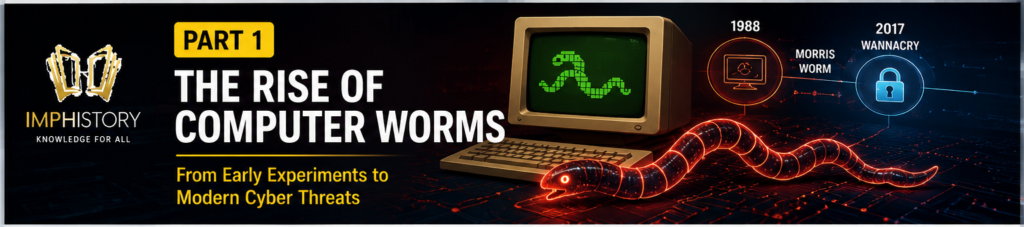
Part 1: From Traditional Malware to Intelligent Cyber Attacks
Introduction
Cybersecurity has always been a race between attackers and defenders. Every time security experts develop stronger protection, cybercriminals search for new ways to bypass it. Over the past few decades, we have witnessed the evolution of viruses, worms, ransomware, spyware, and many other forms of malicious software. Each generation of malware has become smarter, faster, and more difficult to stop.
Today, the cybersecurity landscape is entering another major transformation. Artificial Intelligence (AI), a technology designed to help people solve complex problems, is also changing how cyber threats may operate. Instead of relying only on pre-programmed instructions, researchers are now exploring malware that can analyze its surroundings, make decisions, and adapt its attack strategy based on the system it encounters.
This new concept does not simply represent another type of malware. It represents a completely different way of thinking about cyberattacks.
Recent academic research has demonstrated that AI-powered computer worms can study a network, identify vulnerable systems, modify their attack techniques, and continue spreading with very little human intervention. Although these experiments were performed in controlled laboratory environments, they highlight how future cyber threats could become far more adaptive than traditional malware.
To understand why this development matters, we must first understand how computer worms evolved over the past four decades.
Understanding Malware, Viruses, and Computer Worms
Many people use the words virus, worm, and malware interchangeably, but they actually describe different types of cyber threats.
What is Malware?
Malware is a general term that refers to any software created with malicious intent. Its purpose may include:
- Stealing sensitive information
- Encrypting files for ransom
- Damaging operating systems
- Monitoring user activity
- Disrupting business operations
- Taking control of computers remotely
Malware includes several categories such as viruses, worms, ransomware, spyware, trojans, rootkits, and botnets.
What is a Computer Virus?
A computer virus behaves much like a biological virus.
It cannot spread on its own.
Instead, it attaches itself to another file or application and waits for a user to perform an action, such as:
- Opening an email attachment
- Downloading infected software
- Running an executable file
- Installing pirated applications
Only after the user performs the required action does the virus begin infecting the computer.
Because viruses depend heavily on human interaction, users can often prevent infection by following safe browsing habits.
What is a Computer Worm?
A computer worm is significantly different.
Unlike a virus, a worm does not require someone to repeatedly open infected files. Once it successfully compromises a single machine, it automatically searches for additional vulnerable systems.
It can:
- Scan nearby computers
- Identify open network services
- Exploit software vulnerabilities
- Copy itself to new devices
- Continue spreading without further human involvement
Every newly infected computer becomes another source of infection, allowing the worm to spread rapidly across networks.
This self-replicating ability makes worms especially dangerous inside organizations where hundreds or even thousands of connected devices share the same network.
Why Computer Worms Are So Dangerous
The greatest strength of a worm is speed.
Imagine one infected computer inside a company’s network.
Instead of waiting for employees to open malicious emails, the worm immediately begins searching for other systems. If it finds an unpatched server, outdated workstation, or vulnerable device, it copies itself there automatically.
Now two infected computers begin scanning.
Soon there are four.
Then eight.
Then sixteen.
Within hours, hundreds or thousands of devices may become infected.
This exponential growth is why computer worms have caused some of the largest cybersecurity incidents in history.
The Morris Worm: The Cyber Attack That Changed Internet History
The history of computer worms cannot be discussed without mentioning the Morris Worm, one of the first major Internet worms ever recorded.
In November 1988, graduate student Robert Tappan Morris created a self-replicating program intended to measure the size of the early Internet.
At that time, the Internet was much smaller than today. It mainly connected universities, research laboratories, and government organizations. Because these institutions trusted one another, security controls were minimal.
The worm exploited this trust.
Instead of quietly collecting information, it began copying itself far more aggressively than intended.
Within a single day, thousands of computers experienced severe slowdowns.
Many organizations disconnected themselves from the Internet simply to stop the infection from spreading further.
Interestingly, the Morris Worm did not destroy files or steal confidential information.
Its biggest weapon was its ability to spread faster than administrators could respond.
The incident became a turning point in cybersecurity history.
It demonstrated that even software designed without destructive intentions could cause widespread disruption if replication was not carefully controlled.
The Morris Worm also led governments, universities, and technology companies to take cybersecurity much more seriously.
Many modern incident response procedures trace their origins back to lessons learned from this event.
Traditional Worms Followed Fixed Instructions
For many years after the Morris Worm, most malware followed a predictable pattern.
Cybercriminals would:
- Discover a software vulnerability.
- Write malicious code targeting that weakness.
- Search for computers with the same vulnerability.
- Exploit those systems repeatedly.
The worm always followed the same instructions.
If defenders discovered how it worked, they could usually:
- Release software patches
- Block network traffic
- Update antivirus signatures
- Detect suspicious behavior
- Stop the spread
Although traditional worms could infect millions of computers, security teams eventually learned how to identify and contain them.
The malware itself never changed its strategy.
It simply continued executing the code written by its creator.
WannaCry: A Modern Example of a Global Worm
One of the most famous examples of a computer worm appeared in May 2017.
The ransomware known as WannaCry spread across the world at an astonishing speed.
It exploited a known vulnerability in Microsoft Windows file-sharing services.
Although Microsoft had already released a security update before the attack, many organizations had not installed the patch.
This delay proved extremely costly.
Within days, WannaCry infected hundreds of thousands of computers in more than 150 countries.
Hospitals postponed medical procedures.
Manufacturing plants temporarily stopped production.
Government agencies experienced service disruptions.
Businesses around the world faced financial losses.
The attack demonstrated an important cybersecurity lesson.
Sometimes the greatest weakness is not the software itself.
It is the delay between discovering a security problem and actually fixing it.
Despite its massive impact, WannaCry still operated using fixed programming.
It could only exploit vulnerabilities that its developers had specifically included in its code.
If administrators patched those weaknesses, the worm could no longer continue spreading.
The Limits of Traditional Malware
For decades, cybersecurity professionals understood malware in a relatively predictable way.
Attackers selected targets before launching an attack.
They wrote code designed for known vulnerabilities.
The malware executed those instructions exactly as written.
If unexpected situations occurred, the malware usually failed.
For example, traditional worms could not:
- Learn about new vulnerabilities after deployment.
- Change attack techniques automatically.
- Analyze unfamiliar computer systems.
- Develop new exploitation methods.
- Adapt to different operating systems without updates.
Everything depended on human planning.
If attackers forgot to include an exploit, the malware simply could not use it.
This predictability gave defenders a significant advantage.
Security researchers could reverse engineer malware, understand its behavior, and build protections against future attacks.
A New Era Begins: AI-Powered Adaptive Worms
Artificial Intelligence is beginning to change this traditional model.
Instead of following only pre-written instructions, researchers are now experimenting with systems that can make decisions while they are running.
Imagine a worm entering a network.
Rather than immediately using the same attack against every computer, it first examines each machine.
It asks questions such as:
- Which operating system is installed?
- What services are running?
- Which software versions are present?
- Are there known vulnerabilities?
- Which attack method has the highest chance of success?
If one method fails, it tries another.
If new security information becomes available, it can use that knowledge.
Instead of blindly following a fixed path, it adjusts its strategy based on the environment it encounters.
This represents a major shift in cybersecurity.
The malware is no longer simply executing instructions.
It is making decisions based on available information.
Although today’s research remains experimental and controlled, it demonstrates how future cyber threats may become increasingly adaptive, flexible, and autonomous.
Suggested Internal Links for ImpHistory.com
Link this article to related content such as:
- The History of Artificial Intelligence
- Evolution of Cybersecurity
- How Ransomware Works
- Biggest Cyber Attacks in History
- Future of Artificial Intelligence
- What is Machine Learning?
- History of the Internet
- Understanding Zero Trust Security
History of Computer Worms
“Vintage computer screens connected through an early internet network with digital worm icons spreading between systems, realistic cyber history illustration.”
AI Adaptive Worm
“Artificial intelligence analyzing multiple computer servers and selecting different attack paths using holographic network maps, futuristic cybersecurity visualization.”
Cyber Defense
“Modern Security Operations Center with analysts monitoring AI-powered threat detection dashboards, realistic enterprise cybersecurity environment.”
Future of AI Security
“Artificial intelligence protecting a global digital network with cybersecurity shields surrounding cloud infrastructure, futuristic technology artwork.”





Recent Comments