
For billions of years the universe stored information in silence: atoms arranged into molecules, molecules into cells, cells into organisms. Then something extraordinary happened. Information began predicting itself. Brains emerged — systems that didn’t just react but anticipated. Prediction became survival, survival became intelligence, and eventually prediction became language.
Language let a species simulate reality with symbols: to invent futures, coordinate strangers, and build invisible structures — nations, markets, religions — that persisted across generations. For most of human history, only humans could create language at scale. Then we built a system that could do it too. We call it Generative AI — not because it understands or is conscious, but because it continues human language patterns so convincingly that prediction can look like authorship.
From Magic to Probability
To understand how we got here, we must follow a long chain of discoveries. Generative AI was not a single breakthrough; it was a chain reaction. The story begins in 1948, when Claude Shannon formalized information as something measurable. Shannon’s insight — entropy and the mathematical treatment of information — mattered for one reason: it made language legible to mathematics. Once language could be measured, it could be modeled; once modeled, it could be optimized; once optimized, it could be generated.
Most people think generative AI begins with chatbots. It doesn’t. It begins the moment we stopped treating language as magic and started treating it as probability. For decades neural networks were curiosities rather than revolution. Then, in 1986, David Rumelhart, Geoffrey Hinton and Ronald Williams popularized backpropagation — a practical method for training multilayer networks by propagating error backward through the system. Backprop didn’t just fit curves; it enabled machines to learn internal representations and discover structure without explicit instruction. The future of generation required one thing above all: systems that could learn patterns implicitly.
The Architecture of Memory
Language is not a static snapshot; it unfolds. In 1990 Jeffrey Elman formalized simple recurrent networks so neural nets could process sequences. Recurrence, however, had a problem: it forgot. Gradients faded. In 1997, Hochreiter and Schmidhuber introduced Long Short-Term Memory (LSTM), a gated memory system that maintained context across long sequences. LSTMs gave the industry its first sustained taste of long-range coherence: you could keep memory and generate coherent outputs over longer spans.
Around the same time, statistical machine translation showed a philosophical pivot. In the early 1990s, Peter Brown and colleagues at IBM treated translation as a probability problem — not grammar rules and hand-built dictionaries but choosing the most probable target sentence given a source. This approach proved that modeling how language behaves, at scale, could outperform hand-crafted linguistic cleverness. More data, not more rules, became the new DNA of language technology.
Language as Geometry
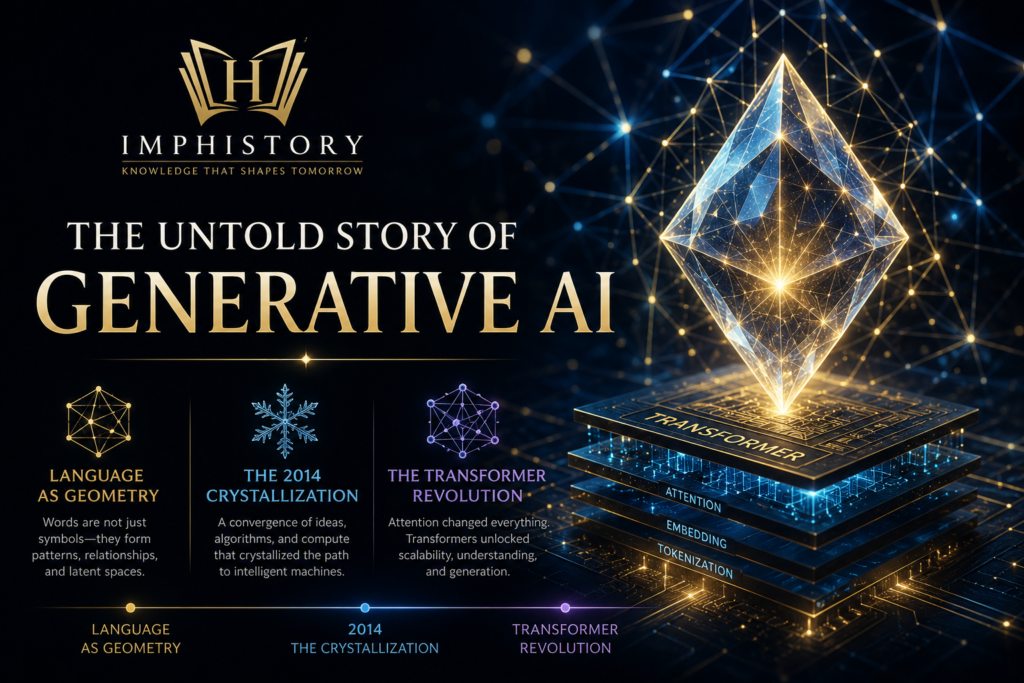
Yet language posed a thorny practical problem: sparsity. By 2003 neural probabilistic language models introduced by Yoshua Bengio and colleagues began to address this by learning word representations that reduced combinatorial explosion. Language became geometry: words turned into vectors and meaning became distance. Once meaning was a space, machines could navigate semantics without “understanding” the way humans do.
The 2010s accelerated everything. In 2012 Alex Krizhevsky, Ilya Sutskever and Geoffrey Hinton used deep convolutional networks and GPUs to shatter vision benchmarks with AlexNet — a cultural earthquake. It proved a brutal rule: with data, compute, and the right architecture, scale wins. Two 2013 innovations further set the stage: variational autoencoders provided a practical latent-variable framework for generation, and scalable word embeddings made semantic navigation cheap and effective. A generative model didn’t need human-like understanding; it needed a compressible structure of meaning.
The 2014 Crystallization
If you had to pick a single year where modern generative AI started to feel inevitable, it would be 2014. Three things crystallized: (1) encoder–decoder strategies for generation, (2) attention mechanisms for learned alignment, and (3) generative adversarial networks (GANs), which redefined image synthesis through adversarial training. The building blocks for generation — encode, attend, decode; or generate, discriminate, improve — were falling into place.
Small engineering solutions mattered too. Subword tokenization, popularized through byte-pair encoding, solved the vocabulary problem by splitting words into manageable units. That small step removed a major bottleneck and allowed language models to scale without choking on rare words.
The Transformer Revolution
2017 was the real inflection point. The transformer architecture, introduced in “Attention Is All You Need,” replaced recurrence with self-attention and massive parallelism. Transformers made huge pre-training feasible and efficient. The slogan became: pre-train, then adapt. In the same year, reinforcement learning from human preferences emerged as an alignment primitive, foreshadowing reward-based fine-tuning methods.
By 2018 generative pre-training approaches crystallized. Masked-token objectives accelerated a culture of large-scale pre-training. In 2019, GPT-style autoregressive models demonstrated broad capabilities and also triggered debates about staged release and misuse — the moment society began to see not only capability but risk. Then in 2020 scaling laws quantified predictable gains from compute and data, and GPT-3 arrived as a cultural artifact with 175 billion parameters. Diffusion models reframed image generation as learned denoising, and generation began to look like a platform: text, images and audio all scaled up.
Mainstream Consciousness and Ethics
A countercurrent emerged. In 2021 Emily Bender and Timnit Gebru published “On the Dangers of Stochastic Parrots,” a critique arguing that fluency is not understanding. Their message was stark: fluent models can amplify bias, create provenance problems, and produce plausible nonsense. It became the intellectual opposition that would haunt the field. That year also saw DALL·E demonstrating the bridge from language to image synthesis: text as an interface for reality generation.
Between 2022 and 2023, generative AI left the lab and entered mainstream consciousness. Efficient scaling strategies (Chinchilla), instruction tuning (RHF/Instruct methods), diffusion-based image models, and open-source initiatives lowered barriers. Stable Diffusion’s public release catalyzed mass adoption and a fine-tuning culture — and with it, new copyright controversies. ChatGPT’s November 2022 launch was decisive not because it was the first model, but because it was the first interface that made the shift feel immediate: a machine that writes back. Export controls on advanced AI chips soon made compute a geopolitical lever, and AI development became not only a software story but an infrastructure and semiconductor story.
The Future of Optimization
Legal battles and governance debates followed. From 2023 onward, litigation from publishers, news organizations, and stock-image companies forced courts and regulators to confront questions: what counts as training data, what is provenance, what is infringement, and what duties do model makers owe society? Generative AI had become a civic and economic force. Language is power; now it can be generated, personalized, and scaled. Probability became optimization, optimization became generation, generation became infrastructure, and infrastructure began reshaping labor, power, authorship, and identity.
Generative AI did not awaken. It optimized. But large-scale optimization can reorganize institutions and livelihoods in ways that feel epochal. For the first time in history, humans are not the only large-scale authors of language. We must now decide how to govern, distribute, and live with systems that can generate the textual fabric of culture itself.





Recent Comments