Four decades ago, Windows 95 took the personal computer out of enterprise server rooms and dropped it into consumer living rooms, changing the world forever. Today, we are standing at the edge of the next massive computing shift.
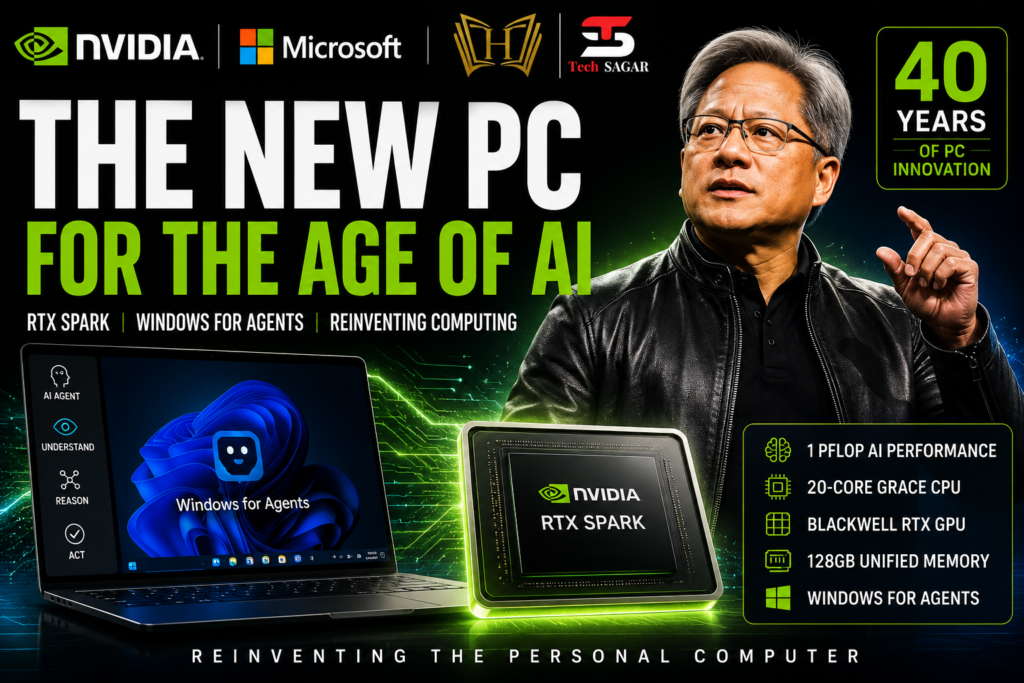
At a recent keynote, NVIDIA CEO Jensen Huang announced a groundbreaking partnership with Microsoft to completely re-architect the PC for the age of Artificial Intelligence. Say goodbye to the traditional PC where you manually open apps and click around; say hello to RTX Spark—the foundation for a world run by autonomous AI agents.
“The PC ten years from now is going to be completely different. There is no question this reinvention of the computer is as big of a deal as the reinvention of the phone into the smartphone.”
— Jensen Huang
What is an “Agentic” Runtime?
Instead of launching static applications, the new Windows operating system combines its classic core with Large Language Models (LLMs). Jensen described LLMs as the “modern version of DirectX.”
On top of this, traditional applications are being replaced by an agentic runtime. These local or cloud-connected agents don’t just wait for you to type; they understand your design intent, look at your sketches, talk to you, detect their own mistakes, and orchestrate complex multi-software workflows on your behalf.
Under the Hood: The RTX Spark Lineup
NVIDIA didn’t just announce software; they unveiled an entirely new silicon architecture built in partnership with MediaTek and TSMC to support these 24/7 autonomous agents.
| Component | Specification |
|---|---|
| GPU Architecture | Blackwell RTX GPU with 6,144 CUDA cores |
| AI Performance | 1 Petaflop |
| CPU Architecture | Custom 20-core Grace CPU (co-developed with MediaTek) |
| Interconnect | High-speed NVLink |
| Unified Memory | 128 GB |
| Manufacturing Process | TSMC 3nm |
| Transistor Count | 70 Billion |
From Idea to Reality: The Agent Workflow
To prove what this hardware can do, NVIDIA showcased a complex architectural design workflow handled almost entirely by a local agent running the Hermes harness connected to Anthropic’s Claude Sonnet.
- Ingest & Understand: The user provides site location, rough concept sketches, and a mood board. The agent analyzes the files and text prompts to understand the core design intent.
- Automated 3D Modeling: The agent autonomously opens Rhino, models the site terrain, calculates setbacks, shapes the building envelope, and self-corrects its own geometric errors.
- Application Handshake: Once the layout is approved, the agent seamlessly exports the entire project into Blender, keeping all materials and object properties fully intact.
- Photorealistic Rendering: Using Generative AI via the Flux.1 model, the agent automatically renders the Blender files into beautiful, photorealistic images from multiple lighting conditions and viewpoints.
Laptops, Desktops, and the “DGX Station”
The ecosystem is expanding immediately into three distinct tiers across global partners like MSI:
- RTX Spark Laptops: Hyper-efficient, ultra-powerful mobile workstations that run 100% of NVIDIA’s software stack.
- The 24/7 AI Desktop: A meter-free home server designed to run continuous local models like Nemotron-3 Ultra. It acts as a private, secure AI sandbox.
- The DGX Station for Windows: The ultimate developer desk-side powerhouse, boasting 768 GB of memory and 20 Petaflops of performance.
Ultimately, NVIDIA envisions a future where every home has an AI supercomputer alongside their home theaters and game consoles—running personal assistants that feel less like a tool, and more like R2-D2.


Recent Comments