
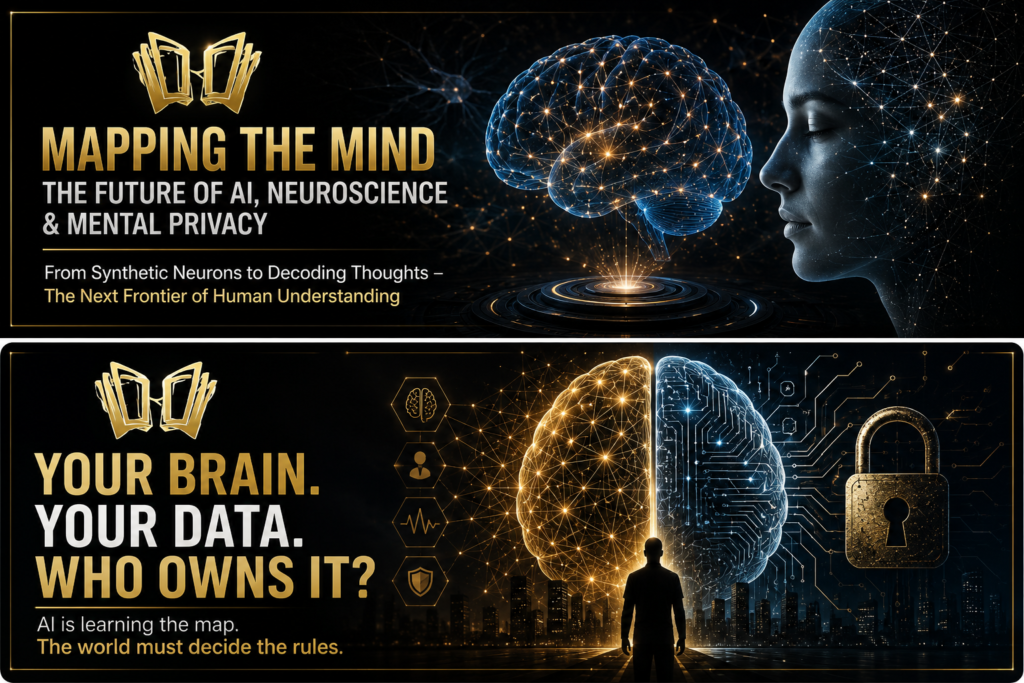
Artificial intelligence has reached another remarkable milestone—one that received surprisingly little public attention.
In April 2026, Google Research introduced Morgen, a new AI model capable of generating synthetic neurons. These are not simplified neural network nodes inspired by biology; they are statistically accurate digital replicas of real biological neurons. Their purpose is to help other AI systems learn how to reconstruct and understand the human brain more efficiently.
At first glance, this may seem like another technical breakthrough hidden inside an academic research paper. In reality, it signals something much bigger.
For more than a decade, Google has quietly been using AI to map the brain in extraordinary detail. Today, the company has reached a point where AI is helping create artificial neurons that train other AI models to understand real ones. While this sounds like science fiction, it represents a significant step toward one of humanity’s most ambitious scientific goals: building a complete digital map of the human brain.
AI and the Quest to Map the Human Brain
Brain mapping is not a new research area. Scientists have spent decades attempting to understand how billions of neurons connect and communicate.
This field is known as connectomics—the study of every neuron and every connection inside the brain.
The challenge is enormous.
The average human brain contains approximately:
- 86 billion neurons
- Over 100 trillion synaptic connections
Every memory, emotion, thought, and decision emerges from these vast interconnected networks.
Creating a complete “connectome” means documenting every one of these neurons and every pathway connecting them.
For many years, this seemed practically impossible.
From a Tiny Worm to the Human Brain
The first complete connectome was published in 1986.
Surprisingly, it wasn’t for a human or even a mouse.
It was for a microscopic worm containing just 302 neurons.
Even with only a few hundred neurons, the project required 16 years of painstaking manual work.
Since then, neuroscience has progressed dramatically.
Researchers have successfully mapped:
- Entire fruit fly brains
- Larval zebrafish brains
- Sections of mouse visual cortex
- Small regions of the human brain
Each achievement required enormous computational power combined with advanced AI.
Yet every step reveals how much larger the challenge still is.
A mouse brain is roughly 1,000 times more complex than a fruit fly brain.
A human brain is approximately 1,000 times more complex than a mouse brain.
At traditional research speeds, mapping an entire human brain would take far longer than recorded human history.
This is precisely the problem Google’s latest AI models aim to solve.
What Is Google’s Morgen AI?
Google’s Morgen model focuses on one of the biggest bottlenecks in connectomics.
To teach AI how to identify neurons from microscope images, researchers require massive amounts of manually labeled training data.
Creating these datasets is extremely time-consuming.
Scientists must inspect microscopic images pixel by pixel, correcting errors where AI accidentally merges two neurons or splits one neuron into several pieces.
Morgen changes this process.
Instead of relying entirely on manually labeled biological neurons, the system generates synthetic neurons that accurately reproduce the branching complexity and geometry found in real brain tissue.
These artificial neurons become additional training data for Google’s reconstruction models.
The result?
Google reported approximately a 4.4% reduction in reconstruction errors.
Although that number may sound small, at the scale of entire brains it translates into an estimated 157 person-years of manual proofreading saved for large connectomics projects.
This represents a major acceleration in brain mapping.
Mapping Human Brain Tissue at Unprecedented Resolution
In 2024, researchers from Google and Harvard published one of the most detailed reconstructions of human brain tissue ever created.
The sample itself was tiny—roughly half the size of a grain of rice.
Despite its size, it contained:
- Around 57,000 cells
- Approximately 150 million synapses
- Nearly 1.4 petabytes of imaging data
The project uncovered neural structures that scientists had never previously observed.
Among the discoveries were:
- Extremely complex axon loops
- Dense clusters of simultaneous synaptic connections
- Previously undocumented neuron arrangements
Even experienced neuroscientists described many of these structures as both mysterious and beautiful.
These discoveries demonstrate how much of the human brain remains unexplored.
AI Is Beginning to Predict Brain Function
Modern neuroscience is no longer limited to creating static maps.
Researchers are increasingly combining structural brain maps with AI models capable of predicting how neural circuits actually function.
Recent studies have shown that AI can analyze a wiring diagram of a fruit fly’s visual system and accurately predict how dozens of neuron types respond to movement—without directly observing their activity.
The simulations successfully reproduced findings from more than two decades of biological experiments.
This represents an important shift.
Instead of merely mapping brain structure, AI is beginning to infer brain function.
Can AI Decode Human Thoughts?
Perhaps the most widely discussed breakthrough in brain-computer interfaces came from researchers at the University of Texas at Austin.
Using functional MRI (fMRI), scientists developed an AI system capable of translating patterns of brain activity into continuous text.
The system does not read thoughts word-for-word.
Instead, it reconstructs the general meaning of what a participant is hearing, reading, or imagining.
For example, if someone heard:
“I didn’t even have my driver’s license yet.”
The AI might generate:
“She hadn’t learned to drive.”
The wording changes, but the meaning remains remarkably close.
This is not science-fiction-style mind reading.
It is semantic decoding—the ability to infer intended meaning from patterns of brain activity.
The Rise of Brain Language Models
In 2025, researchers introduced another major advancement known as BrainLLM.
Rather than treating brain activity separately from language models, BrainLLM integrates neural recordings directly into large language models.
Researchers found that brain signals improved AI performance, especially when interpreting unexpected or unpredictable language.
The results suggest that neural activity contributes meaningful information beyond what language models can predict from text alone.
Although these systems currently require specialized laboratory equipment and extensive training for each participant, they demonstrate the rapid progress occurring in AI-assisted brain decoding.
Mental Privacy in the Age of AI
Today’s brain decoding technologies remain limited.
They require expensive imaging systems, participant cooperation, and controlled laboratory conditions.
No current technology allows companies or governments to read people’s thoughts remotely or without consent.
However, the direction of research is becoming increasingly clear.
Portable neurotechnology—including wearable sensors capable of measuring aspects of brain activity—is advancing rapidly.
As these technologies improve, concerns about mental privacy are growing.
Researchers and ethicists argue that neural data deserves protections similar to genetic information because it may eventually reveal:
- Attention levels
- Emotional responses
- Decision-making patterns
- Cognitive fatigue
- Personal preferences
Unlike traditional biometric data, neural information has the potential to expose aspects of an individual’s internal mental state.
The Expanding Neurotechnology Industry
The global neurotechnology market is growing quickly.
Consumer devices such as:
- Smart earbuds
- Augmented reality headsets
- Wearable sensors
are increasingly collecting physiological signals related to brain function.
Privacy experts have raised concerns that future devices may gather neural information without users fully understanding its implications.
Organizations including the Neurorights Foundation and UNESCO have called for stronger legal protections governing ownership and use of neural data.
Several governments have already begun introducing legislation addressing neural privacy.
Building Better AI Through Brain Mapping
One of the most significant implications of connectomics extends beyond medicine.
Modern artificial intelligence was originally inspired by biological neurons, but today’s neural networks remain only rough approximations of the brain.
A complete understanding of brain circuitry could inspire entirely new AI architectures.
Rather than simply scaling larger models with more parameters and computing power, future AI systems may borrow directly from biological design principles refined through millions of years of evolution.
Researchers are already creating digital simulations of brain circuits detailed enough to generate new scientific hypotheses.
Some scientists have even begun asking profound philosophical questions:
If a brain simulation becomes sufficiently accurate, could it eventually exhibit some form of consciousness?
At present, nobody knows the answer.
Balancing Innovation and Ethics
The benefits of brain mapping are enormous.
Researchers hope these technologies will improve treatments for:
- Alzheimer’s disease
- Parkinson’s disease
- Stroke recovery
- Paralysis
- Speech disorders
- Neurological diseases
At the same time, the same tools capable of restoring communication for patients could eventually raise complex ethical questions about privacy, autonomy, and ownership of neural information.
Technology often advances faster than legislation.
Brain mapping appears to be following the same pattern.
Looking Ahead
Google’s Morgen project is more than another AI research paper.
It represents a significant step toward accelerating one of the most ambitious scientific efforts ever undertaken: understanding the complete wiring diagram of the human brain.
Progress remains gradual.
Researchers have not yet mapped a complete mouse brain, and the human brain remains vastly more complex.
Yet each improvement—whether a 4.4% reduction in reconstruction errors or a new AI-generated synthetic neuron—brings that goal closer.
The deeper question is no longer whether AI will continue learning how the brain works.
It is whether society will establish ethical and legal frameworks before that understanding becomes powerful enough to challenge one of our most fundamental assumptions—that our thoughts remain entirely our own.
Conclusion
Artificial intelligence is rapidly transforming neuroscience. From generating synthetic neurons to decoding semantic meaning from brain activity, AI is helping researchers uncover mysteries that once seemed impossible to explore.
These advances hold extraordinary promise for medicine, scientific discovery, and the development of future AI systems. At the same time, they introduce new questions about privacy, data ownership, and the ethical boundaries of neurotechnology.
As brain mapping accelerates, one question may ultimately become more important than the technology itself:
If a complete digital map of the human mind can one day exist, who should own it?
MS Intune Interview Questions and AnswersTop 50 Microsoft Intune Interview Questions and Answers Updated – Interview


Recent Comments