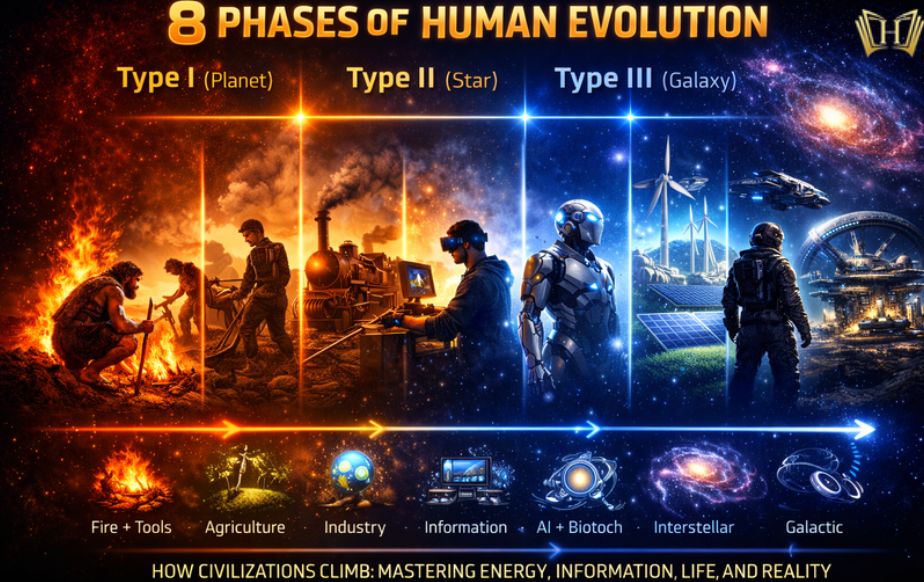
Progress follows a predictable pattern: civilizations climb by mastering energy, information, life, and reality. Nikolai Kardashev's 1964 scale measures energy use—Type I (planet), II (star), III (galaxy)—placing Earth at ~0.73 today, still fossil-dependent. These eight phases expand it, showing how we advance, with 2026 marking AI/biotech acceleration. Humanity nears Type I, but risks like emissions and AI ethics loom
Phase 1: Control of Energy (Survival to Industrial Power)
Early humans bowed to nature—muscle, wind, water halted at night or famine. Fire (~1M years ago) defied darkness, safened food, enabled migration. Agriculture (10K BCE) fixed supplies, spawning cities.
The Industrial leap—coal/steam (1700s), oil/rail (1800s), electricity (1900s)—mechanized output: one worker + machine = 100 manual. 2024 stats: demand +2.2% (electricity +4.3%), renewables 38% new supply, fossils 81% (66% emissions). Fusion prototypes (NIF 2022) hint at Type I (~10^16 W). Challenge: net-zero transition. Energy scales bodies; info scales minds.
Phase 2: Creation of Intelligence (Tools to Thinkers)
AI evolves from rules (1950s) to learning nets (2010s): patterns, generation, optimization. 2024: 78% firms adopt (from 55%), US invests $109.1B (12x China), genAI $33.9B. FDA: 223 devices (vs. 6 in 2015); Waymo: 150K autonomous rides/week.
Industries automate cognition—productivity surges 20-50%. 2026 trend: agentic AI handles workflows, pushing Phase 3 peak.
Phase 3: Control of Information (Memory to Global Network)
Writing (3200 BCE) outlasted brains; Gutenberg's press (1440) democratized knowledge; telegraph/radio (1800s) shrank distance; computers (1940s) digitized; internet (1990s) linked all.
Today: 5.5B online (68%, +3.4% YoY)—93% high-income, 27% low; 2.6B offline. Zettabytes flow; markets react in ms. Bottleneck: human processing lags data explosion, birthing AI.
Phase 4: Mastery of Matter (Bulk to Atomic)
From stone tools to chips, now nanotech assembles atom-by-atom. 2025 market: $105.79B to $398.41B (2034, 15.7% CAGR); US 29%. Yields: super-materials, nano-drugs, quantum chips—scarcity wanes.
2026: AI-designed nanomaterials boost batteries 5x. Scalability/toxicity hurdles remain.
Phase 5: Stellar Engineering (Planetary to Stellar Energy)
Sun: 3.8×10263.8×1026 J/s (1s > yearly human use). NIF (2022): 3.15 MJ net fusion gain. Dyson swarms harvest stars (Type II: 10^26 W).
Enables: geoengineering, exaflop computes, Mars bases. ITER (2030s) scales it; 2026 private fusion races.
Phase 6: Engineering Biology (Fate to Design)
AI turns inward: edit humans. CRISPR (2012) snips DNA; mid-2025: 36 gene/36 RNA/71 cell therapies approved. Casgevy (FDA 2023) cures sickle cell (16K+ US patients). BCIs (Neuralink) decode thoughts.
Life expectancy nears 100+; aging editable. Ethics: access gaps, off-target edits. Physics caps biology—atoms next.
Phase 7: Mastery of Fundamental Physics (Laws to Levers)
Quantum computers exploit superposition: 6,100-atom array holds 13s coherence (99.98%). Cracks sims classical can't—drugs, fusion.
Warp metrics? Antigravity? 2026: error-corrected qubits hit 1K, merging eng/physics.
Phase 8: Galactic Civilization (Stars to Galaxy Net)
Milky Way: 100-400B stars, 100K ly, 6K+ exoplanets. Type III (10^36 W): galaxy-spanning minds, wormhole travel.
Post-bio intelligence networks stars. Each phase breaks prior limits—complexity drives leaps.